How could anyone possibly think that? Only an idiot would choose them! Those people are crazy.
New Zealand has just held our general election, and the above are a (very, very small) sample of the comments we heard in the lead-up. Before you start blaming the left or right for ‘their’ lack of decorum, these statements spanned all areas of the political spectrum. They came from friends, family and probably our own (usually very reasonable) mouths.
This tells us two things:
1/ How strongly we believe our own views.
2/ How quickly we label anything different as ‘wrong’.
It’s all very interesting, because according to our highly scientific LinkedIn poll, 69% of you say that when a conversational flashpoint arises, your immediate response is to get curious and ask questions.
Scrap political views; our views about our own behaviour are delusional.
Fight, flight or freeze
A while ago, we made a case for getting more comfortable with conflict. Our advice was to practice disagreement through low-stakes conversations. What we didn’t cover is how to disagree.
We all know that our bodies respond to psychological threats in the same way as physical ones. Kristen’s response to a shark on a surf trip is very similar to Nat’s when an acquaintance tells her that ‘poor people need to work harder’. In both cases, our fight, flight or freeze response kicks in.
When a situation meets our personal threshold for conflict, it becomes very difficult to stay calm and rational. But in a world that’s increasingly divided, we don’t think the answer is to avoid important conversations.
So how do we have them?
The good news is that in the last few weeks, we’ve also seen excellent examples of really productive disagreements. Not from our politicians, obviously. 🤣 The tactics these people use are very similar to those we should all embrace every time a disagreement (or potential disagreement!) arises:
1. Don’t assume you’re right
We all have blind spots. Yes, even you. Our worldviews are shaped by personal experiences, and often disproportionately by a few significant life events. Those beliefs you hold deeply? They’re probably the result of things that happened to you or around you. The person sitting next to you probably has an entirely different set.
We have to accept that the lens we’re looking through is distorted. It’s an incomplete picture of the world, which means it’s likely that none of us is 100% right about anything.
2. Don’t assume people share your views
Your colleagues may have all ended up in the same place, but their backstories will be wildly varied.
At our last company, we asked where everyone was born – very few people named the same city. Add culture, skin colour, religious beliefs, upbringing, finances, etcetera, etcetera, and we all have lived truly unique lives.
Just because someone looks or acts like you, it doesn’t mean they think like you. And, even if you’re usually on the same page, you’ll probably disagree at some stage – that’s a good thing.
3. Don’t try to ‘win’
The first thing you should always ask yourself when voicing your disagreement is “am I open to changing my mind?” If your goal is to convince someone else that you’re right, you’ll always lose. Not only is it very rare for anyone to change their opinion through brute force, it also means you miss out on the opportunity to challenge your own thinking.
Not ‘winning’ is even more important when you’re speaking to people who do agree. How fabulous is it to sit around reinforcing your shared beliefs? It’s so comfortable, so validating. And such a powerful way to avoid pressure-testing your assumptions.
4. Don’t engage with people who are only trying to win
This is where most of us muck up. When faced with a concrete wall, we push harder instead of walking around it.
If someone is trying to force their opinion on you, you’re on a fast path to unproductive conflict. So before diving into the drama, ask them the same question as you just asked yourself: “Are you open to changing your mind?”
It’s ok if they’re not. Nat will never agree that pineapple is bad on pizza. Kristen will never admit Crocs are a fashion crime. We jest, but on some topics, we’re all pretty fixed. Diversity is what makes the world interesting, so it’s ok to agree to disagree. If you can learn more about their perspective without the temperature rising, go for it. But don’t bother trying to relitigate the issue – concrete walls don’t tend to budge.
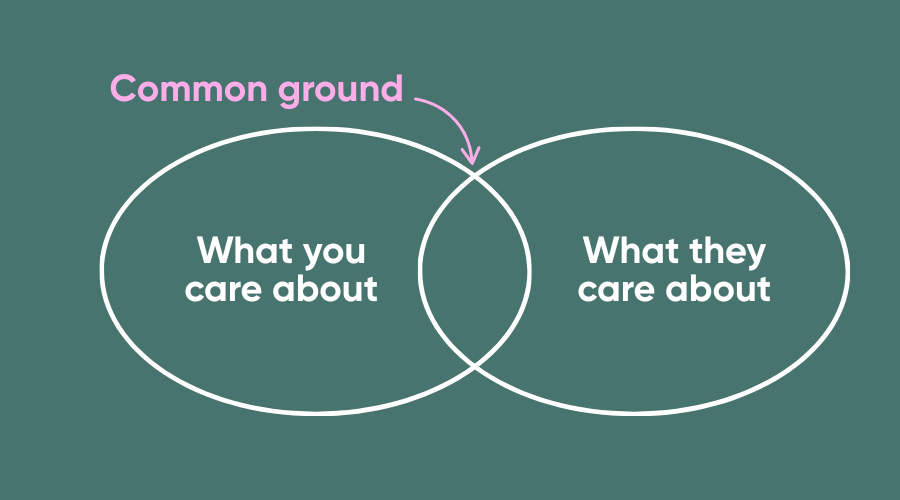
5. Find common ground first
If you followed the recent US midterms at all, you’ll have seen a few exemplary examples of finding common ground – on traditionally no-go topics like abortion. These politicians gave us a masterclass in respectful disagreement by focusing first on what each side agrees on.
This is such an easy way to disarm conflict and start working as a team on the best way to get there. But most of us skip this step – to our own detriment.
A better outcome
We’ve all seen the outcomes of groupthink gone wrong and decisions that went unchallenged. Disagreement is an incredibly powerful antidote. It helps us challenge social norms, drive better outcomes and spot risks that any single person or group might overlook. But when we do it, we have to do it well.
Insults, arguments and echo chambers take us nowhere. So, next time you disagree with someone, don’t stay silent or start arguing. Use it as an opportunity: If you both leave understanding a different perspective a little more, you’ve succeeded. If those different perspectives change any of your views (even a little!), that could be a real win.
Common ground isn’t soft, it’s strategic When it comes to difficult situations, there’s one inescapable truth: it’s much harder to resolve a conflict or overcome a disagreement without first finding common ground.