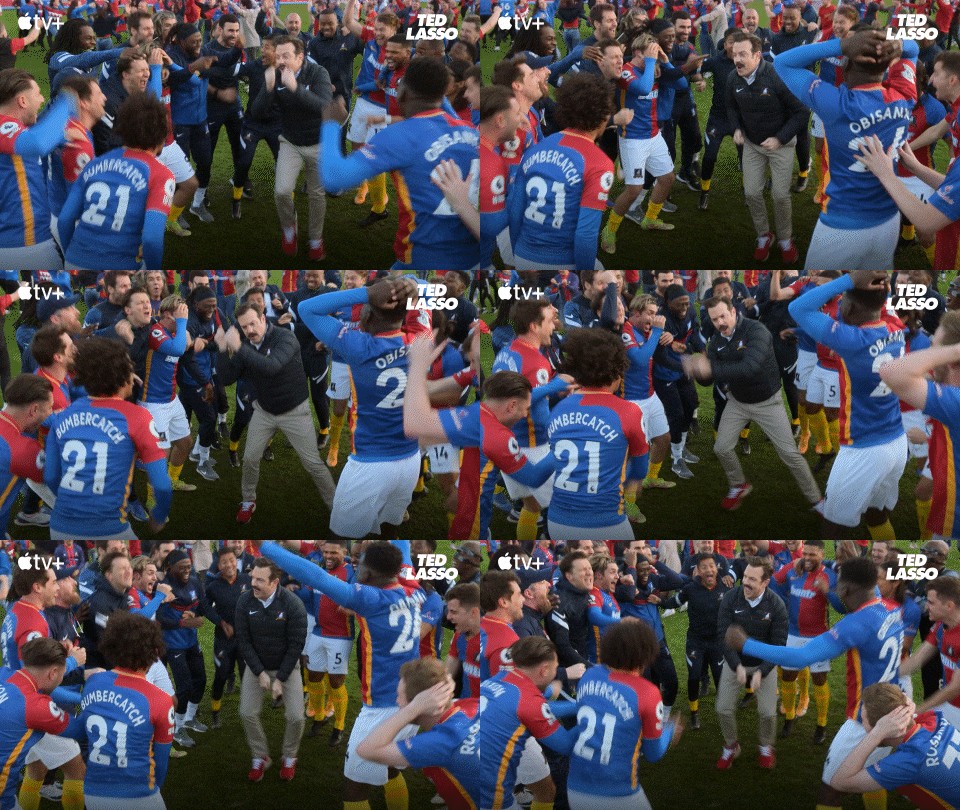
If you haven’t watched Ted Lasso, immediately stop reading and binge all four seasons. It follows a fictional football team, but a darts game stole the show. We’re not sure of the time limit on #spoilers, so suffice to say, Ted delivers a masterclass on curiosity.
During this year’s Men’s World Cup, Instagram served us another football-themed example of what happens when curiosity is cast aside: The 1971 Women’s World Cup. We fact-checked this because, quite frankly, it’s hard to believe there even was one. It’s harder to believe 100,000 people crammed into a stadium to watch it, and it’s almost impossible to imagine it happening over fifty years ago.
According to a 2023 documentary, the tournament proved women’s football could draw crowds and turn a profit. In response, officials buried it.
Why was nobody curious enough to ask what it could mean for the sport? Why did the record-breaking groundswell not grow into a commercially successful, globally popular tournament? Why is women’s football only just starting to get recognition?
Control, ‘expertise’, fear. Take your pick.
Curiosity didn’t really kill the cat
Recently, we interviewed futurist Lynn Casey about the importance of curiosity in an AI world (members, it’s now available to watch on demand). We’re happy to share a spoiler for this one: Curiosity is a career superpower.
As AI takes on more of the work that used to fill our days, the thing that differentiates us from the robots is our ability to do what only we can: be human. All the context, nuance, scepticism, and connections our brains make are how we turn quick results into great outcomes. And all of those human traits get sharper when we’re curious.
It got us thinking about what curiosity really means. Google says it’s the “desire to explore, discover, and learn”. We’d replace ‘desire’ with ‘action’, because wanting to be curious and being curious are two very different things.
Curiosity isn’t conditional
If you’re reading this, you probably think you have nothing in common with a bunch of men protecting their (football) patch in the seventies. We intuitively find their actions repulsive, but are we really so different?
Most of us treat curiosity as something we intentionally apply, so we usually only apply it when we’re feeling comfortable or in control. But when we’re anxious, uncertain or have something to lose, self-preservation kicks in, and curiosity vanishes.
Think about how curious you are when changes are announced, when you disagree with others, when you feel out of your depth, or when you receive tough feedback. How often are you curious in conversations about gender, religion, politics and race? How often are you absolutely certain of your opinion? How often are you too busy proving it to wonder if you could be wrong?
We may all desire to be curious, but how often do our everyday actions reflect that desire? The good news is we can build the muscle in the easy times, so it’s fit and ready when the hard ones arrive. As Lynn says, “curiosity isn’t just interest; it’s going as broad as possible. It’s looking, leaning in, asking.” Even when it doesn’t directly impact you. Even if there’s no ‘point’ to it. So, here’s a non-exhaustive list of simple ways to do just that:
Ask how: Got a routine, process, or habit you’ve never questioned? Experiment with different ways to achieve the same thing.
Ask why: Learn the story behind something you use every day. Why is the QWERTY keyboard laid out that way? Who decided red means stop? Where does the phrase ‘bite the bullet’ come from?
Ask the ‘dumb’ question: Worried that not knowing something will make you look less competent? Ask anyway.
Ask kids: Quiz your kids or niblings about what they’re wondering about (please tell us what they say).
Ask a friend: Invite them to tell you something they think you’re wrong about.
Ask an opinion: The newest person on your team (or someone from a different generation) may be seeing things the rest of you have stopped noticing. Ask what they’ve spotted.
Explore the context: Reporting on numbers or stats? Dig into what’s influencing them (and what they really mean) before you report them.
Burst your bubble: Read, watch or listen to something completely outside your field, political leaning or interests.
Switch on: Notice when you check out because a topic doesn’t concern you, and stay engaged anyway.
Play: Spend fifteen minutes playing with a new tool, Lego, or gadget – with no goal or use case.
Chat to a stranger: Uber drivers, baristas, a different generation, the person next to you at the school gates. Find out what’s happening in their world.
Try a new hobby: Preferably one you have no talent for, and be a beginner again.
Learn a new word: Bonus points if you start using it in everyday life.
Take the other side: Make the strongest case you can for the opposite of any position you hold.
Back to the stadium
None of these acts of curiosity alone would have changed the history of women’s football. But a room full of people who’d practised asking “why” instead of protecting their patch might have posed a very different question: how could this be great, instead of what does this threaten?
We can all do the same. So, the next time you feel that flicker of self-preservation creep in, challenge yourself to get curious instead.
What if it all works out? The power of positivity We spend too much time thinking about everything that could go wrong, instead of planing for it to all go RIGHT. Learn how to default to positivity.
Men deserve better, too The mental health stats for men are heartbreaking, and they deserve better.
Get bite-sized career development, straight to your inbox
Bite-sized career development, straight to your inbox