Recently, we spoke to a Powrsuiter who felt disconnected from her colleagues. She’d just completed onboarding at a new organisation and missed the regular team connection and knowledge sharing that came with it.
We asked: “Why don’t you organise a catch-up?”
It had never occurred to her to take the initiative. She’d mentally filed that type of thing under Leadership Responsibilities and assumed she needed to wait for someone else to do it.
She’s not alone.
Following isn’t just for sheep
Organisations invest heavily in leadership development. It’s a smart move, but followership development could arguably be far more impactful. We spend most of our careers reporting to a manager. Learning to follow makes us more effective, more valuable, and more likely to be promoted.
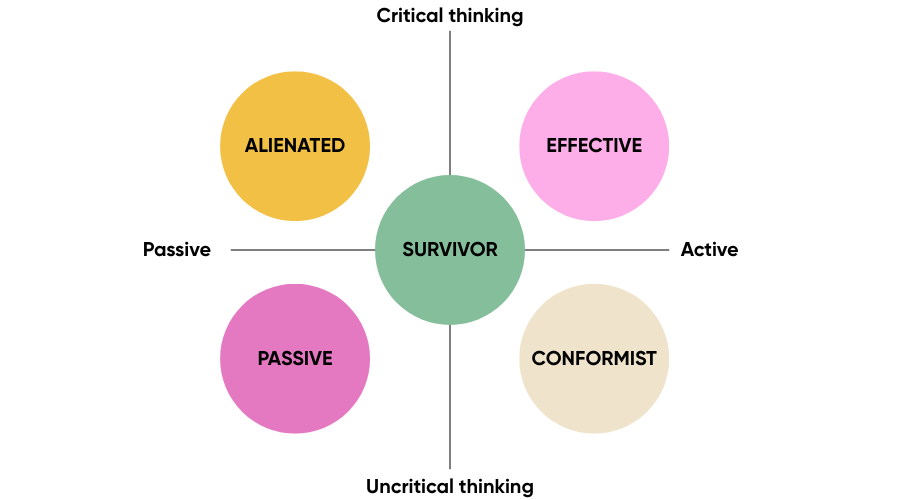
Back in 1988, Robert Kelley mapped what he called “followership styles“. In shocking news, that was almost half a century ago. The upside is that the styles don’t seem to have shifted as much as our tolerance for staying up past 10pm 9pm. Here’s roughly how they break them down:
Passive: Waits to be told what to do, does the task, then waits again.
Alienated: Channels sharp, independent thinking into cynicism and criticism.
Survivor: Prefers status quo, doesn’t rock the boat, and focuses on surviving change.
Conformist: Highly engaged and hardworking. Diligently follows directions rather than challenging or pushing back.
Effective: Proactively assumes responsibilities. Comfortable sharing their views and constructive criticism, even with leaders.
Work smarter, not harder
Yes, the qualities that make an effective follower look a lot like those found in effective leaders. That’s not a coincidence. They’re often the same people playing different roles at different times: following their own manager while leading a team.
There’s a lesson in there: learning how to be an effective follower will make you a more valuable contributorand a better leader. However. If you identify as a people pleaser or have a low tolerance for conflict, you might accidentally have fallen into a less effective style. Not because you’re not capable, but because you think you need to wait for permission or that it’s not your place to share your thoughts.
You think you‘re respecting hierarchy and being a great team player. Meanwhile, your manager is waiting for you to show critical thinking and initiative before they consider that promotion.
Effective followership requires two things that the other styles are missing:
1. Active engagement
Effective followers are self-aware; they understand their strengths and visibly work toward the organisation’s goals. Practice this by:
Taking initiative: Not waiting to be asked before taking action. Learning when and how much initiative to use (more on that in a future newsie).
Supporting colleagues: Understanding your role in the wider system and building relationships across the organisation. Noticing a colleague is stretched and offering to help without being asked. Sharing information that would be useful, even when it’s not your job.
Effective followers think for themselves and exercise judgment. As a result, People Leaders feel safe delegating without close supervision. Practice this by:
Forming your own views: Coming prepared with a point of view and contributing it, instead of just answering questions and delivering on ‘instructions’.
Constructively challenging ideas: Respectfully flagging risks and sharing insights that may change current thinking.
Bringing solutions: Flagging problems, with context and suggested next steps. Owning mistakes.
The best followers become the best leaders
In a culture that celebrates leaders, it’s easy to assume that being a follower makes us passive or powerless. It doesn’t. It’s just a role – one we all play in different contexts. Yes, all of us.
And playing it well pays off. Effective followers are more likely to be promoted, more likely to be trusted with responsibility, and less dependent on having a good manager to perform well.
Turns out, you don’t grow into leadership. You follow your way there.
Psst: Powrsuit helps your talented, hardworking people become effective followers – reducing the load on managers while boosting performance and retention.
30 second action:
Apparently, the vast majority of us identify as Effective Followers. Statistically, most of us will be wrong. So, identify your current style.
Was this helpful?
YesNo
You may also like...
Are you taking initiative, or taking over? When initiative is literally in the job description, why does it backfire? Well, the problem isn't initiative; it's knowing the right level to apply.
Stop asking for permission Seeking permission puts our hard-earned power back in other people's hands, so it's time to change our approach.
Procrastination: Stop stalling, start doing We all put off important stuff, even though we know it’ll come back to bite us. We all do it, we’re all aware we do it, and we all seem unable to kick the habit despite knowing how irrational it…
Get bite-sized career development, straight to your inbox
Bite-sized career development, straight to your inbox