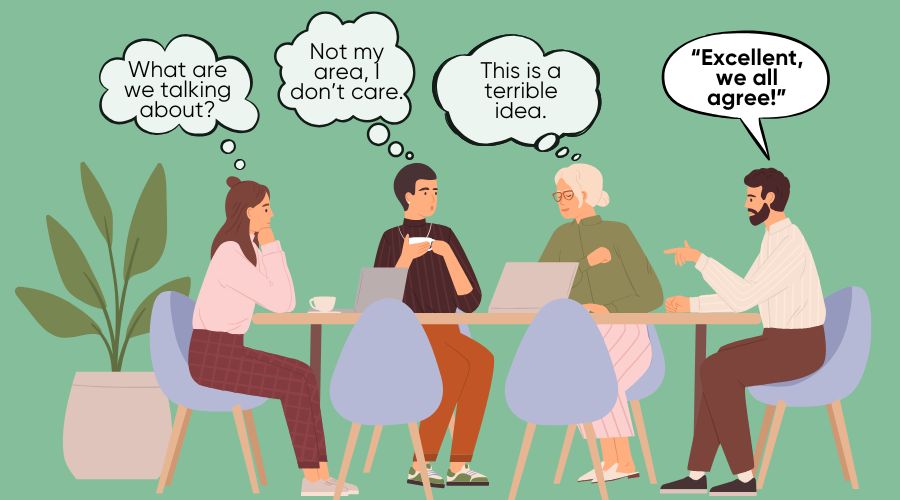
Last week, a Powrsuiter recounted a tough situation. While she repeatedly reassured us that “everything is fine”, her tone and slumped shoulders told a different story.
Books are simple to read. People aren’t. When written, words carry the full load, but in social situations, they play a surprisingly small role. The majority of the ways humans express how we feel are non-verbal: Body language, tone, timing, and all the things we don’t say.
Learning how to read these signals is a skill, especially in groups and when power dynamics are at play.
What is reading the room?
Have you ever walked into a welcoming room? Spotted a sceptical glance? Felt tensions rise? Those are all examples of reading the room – noticing what’s happening, even when it’s not explicitly said.
It’s not easy. Our brains are constantly absorbing a huge amount of information, then we filter it through our individual personality types, wiring and cultural expectations. Some of us are highly attuned to subtle ‘norms’, others are still decoding why “we should catch up sometime” usually means “It’s never going to happen”.
That’s the challenge: Not all rooms speak the same language. And because we view them through our own lens, two people can see the same situation very differently. In this way, reading the room is exactly like reading a book: Open to interpretation. No one is perfect; we all have to continuously practice leaving bias and baggage at the door, while staying curious.
It takes effort, but it’s worth it.
Why it matters
Sometimes, we get stuck in our own heads. We’re so busy worrying about how we’ll be perceived that we stop paying attention to what’s happening around us. This usually lands us in the exact position we’re trying to avoid. We don’t ask the question, miss obvious cues to interject, push our point too hard, get defensive, or don’t address doubt until it’s too late.
By moving focus away from ourselves, and into the room, we enhance our influence, relationships and communication. That’s because reading the room is a means to an end – when we understand how people are responding, we can adapt. Our conversations become more productive, and we come across as more perceptive and credible.
3 ways to practice reading the room
There is no one-size-fits-all formula, but there are ways to ensure our perceptions more closely align with reality:
1. Pay attention to what’s being said
Listening is a verb; it takes intention. But most of us default to listening to respond, or not really listening at all. Active listening is a way to constantly re-examine our assumptions and stay focused on what’s really happening in the room. A few things to listen for:
Challenge: Tough questions and feedback can signal resistance or engagement. There’s a difference between dismissing an idea (“that won’t work”) and pressure-testing it by digging into specifics (“won’t that impact revenue?”). Challenges always offer valuable insight into perceived risks and priorities, and can also unearth advocates in disguise.
Rephrasing: When someone restates a point in their own words, they’re probably taking it seriously. These people can act as valuable ‘bridges’, embedding shared understanding.
Ownership: When people move from “they” to “we”, they’ve bought in. The reverse is also telling.
Interruptions: Who holds (and loses) the floor can reveal hierarchy; what voices carry weight and what dynamics are at play.
2. Listen to what’s not being said
Because words only make up a portion of how we communicate, we need to read between the lines. Some cues:
Silence: People often avoid saying “I disagree” directly by saying nothing at all. Same goes if an idea or topic is never mentioned again.
Vagueness: Vague responses usually mean weaker commitment – anyone who ever asked their parents for a pony knows that “maybe” = “no”.
Emotions: Body language, like crossed arms, posture changes, looking away, and conversational pace, can all indicate that emotions are taking over.
Alignment: Quick glances, side conversations, or pre-agreed positions mean consensus is being built outside the room.
Disengagement: Slack-checking or email-scrolling may signal boredom, overload, or resistance.
3. Track shifts over time
Notice how when you know someone really well, you can instantly tell what they’re thinking (even when it’s invisible to everyone else)? That’s because we get better at reading people the more we know them.
A baseline understanding of how key stakeholders operate makes it easier to spot deviations. We can also track shifts during a conversation by observing patterns:
Engagement: Who’s moved from actively contributing to passively observing? Have anyone’s reactions become more or less subtle?
Tone: When does the energy or tone shift – and what was said immediately beforehand? Did someone show up with a different attitude than usual?
Attention: Who consistently zones out at certain topics? They’re telling you what’s not a priority for them. Conversely, what always gets attention?
Ask, don’t guess
Social cues aren’t universal. Silence can mean respect or disagreement. Indirect language can signal politeness or avoidance. Enthusiasm can be visible or restrained.
You don’t get an award for reading the room on your own, but you do reap the rewards when you get it right. So, when in doubt, don’t rely on perception. A well-placed question showcases your excellent communication skills while delivering valuable intel:
“What does success look like for this meeting?”
“How is this landing?”
“I’m sensing some hesitation. What concerns should we address?”
“It seemed like X resonated, Y raised questions – have I got that right?”
“Let’s get together after this so I can get your thoughts one-on-one”
30 second action:
Pick one cue and track it throughout your next conversation.
Got a seat at the meeting table? Make it count. Women have a seat at the meeting table but still struggle to have our voices heard. These well-known techniques will help establish your leadership presence.