Meeting overload is going nowhere – it’s getting worse. From endless back-to-backs and overbooking to poor structure and facilitation, meetings are the number one calendar killer for Powrsuiters.
It’s not all bad; meetings can be a powerful tool for collaboration, connection, alignment, and consensus-building. But they’re not the only tool. It no longer makes sense to hit every workplace problem with the same old hammer when we now have access to an entire garage full of sharper, lighter, more effective options.
Last year, we shared 10 meeting hacks to save time, and it’s time for 10 more. If every subscriber saved just 30 unproductive minutes, we’d collectively free up over 3,400 hours – a massive time dividend. So, we invite you to pick your tip and help clear the calendar chaos:
1. Treat meetings as a last resort
Somewhere along the line, we’ve demoted the importance of solo thinking and deep work and placed a premium on live collaboration. A problem shared may be a problem halved… But it takes twice as much time and effort.
Meetings have also become an accountability hack. It’s much harder to own our time than it is to let meetings dictate priorities and deadlines.
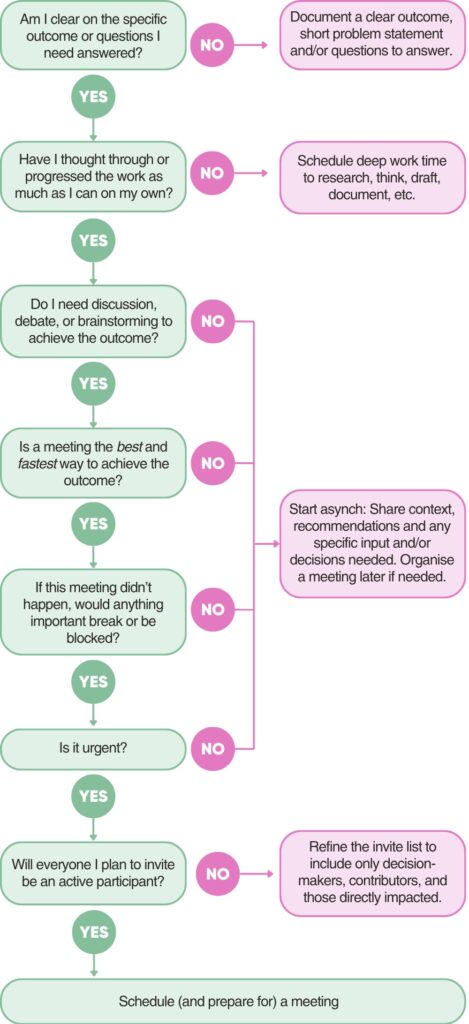
We need to stop treating ‘work’ and ‘meetings’ as synonyms and take back control. Start with a mindset shift: Meetings are a last resort, not the default. Use this quick decision flow before booking your next one.
2. Calculate the true time cost
As Powrsuit expert Jennifer Heuett noted, many of us treat our calendars as a wishlist instead of a reflection of how we spend our time. Meetings are virtually never contained to a single block, but do you schedule more for prep, pre-meetings, buffer, follow-up and actions?
By timeboxing each of these, we make our full workload visible – making it easier to decide what needs to be dropped, delayed or discussed with your manager. We also reduce the mental load of worrying about all the stuff we should be doing but never get around to.
3. RSVP
We’re shocked by how many people ignore calendar invites. It looks like you’ve either lost control of your calendar or your manners.
If you’re invited to a meeting, don’t wait until the day of RSVP, as soon as you can with a ‘yes’ or ‘no’ – include a reason with the latter. If you’re tempted by the ‘maybe’ button, take it as a sign that your attendance isn’t necessary. Send your thoughts and ask for the meeting notes.
4. Curate an exclusive VIP invite list
Remember those parties that spread like wildfire on Facebook? Thousands of teens would descend on a house, causing chaos.
Many of us treat meetings the same.
We’re all about inclusive workplaces, but when it comes to meetings, we embrace exclusivity. Your invite list should only include people who decide, contribute, or are directly impacted by the outcome. Everyone else gets the Facebook photo dumps transcript (you do use these, don’t you?). AI isn’t perfect yet, so edit for clarity and include actions, owners, key decisions and remaining to-dos before sharing.
5. Agree to attendance rules
Think everyone treats meetings like you? Think again. We see the full gambit: From Powrsuiters who set up auto-declines and fiercely protect non-meeting hours, to those who accept every invite that comes their way – even if they’re already triple booked. So, if you haven’t already, co-create a set of rules:
What role/s need to attend (e.g. decision-maker, contributor, etc)? What information should we consume async instead? What meetings are we expected to decline by default? How do we handle double bookings? What are the acceptable way/s to decline without friction?
Review and tweak regularly. And celebrate saying ‘no’ by asking everyone to share one meeting they declined every week – or why they couldn’t.
6. Don’t use meetings for status updates
COVID saw the rise of ‘update’ meetings. When managing rapid change, uncertainty, and fear, bringing people together is the right tool for disseminating information.
But they seem to have become a habit. There is zero value in reading BAU updates out loud to a group – we can consume that information in our own time. So, use short explainer videos and editable docs for structured asynchronous updates. If you get a lot of feedback, it’s time to bring people together.
7. Ban hybrid meetings
We’ve all been in meetings where some attendees have joined together, and others are tuning in from their own devices. Add poor quality sound and side conversations, and they quickly become a total waste of time.
If you have great tech setup and facilitation skills, you might be an exception, but there are usually only two ways to run a meeting:
Remote: Everyone joins from their own device – even if they’re in the same place.
In-person: Organise a time when everyone can attend in person.
8. Don’t be a lazy facilitator
Meeting facilitation is a skill, and it usually falls on the organiser. So:
Prep: Meetings aren’t for status updates (see tip 6). Share context and pre-reading in advance, and treat them as read.
Channel: Set attendance expectations (see tip 7).
Input: Ask for input in advance – and permit attendees to opt out if their contribution is covered.
Timing: Don’t default to an hour when 15 minutes is long enough.
Hard stop: Announce a hard stop time and stick to it (or finish early).
Engage: Actively pull in quieter voices: “Judy, I’d love your thoughts on this point”.
9. Always end with an outcome
If nothing is decided or assigned, your meeting has just created another meeting. Always end with:
What was decided Who owns any actions What happens next
10. Busy isn’t productive
We’ve all experienced the pain of talking to a wall of blank stares and default ‘camera off’ tiles. And we all know that being physically present isn’t the same as being productive.
If you’re wiped out from back-to-backs or multi-tasking your way through meetings, it’s time for an honesty call: You can’t be everything, everywhere, all at once. Challenge yourself to one experiment every week to clear some calendar chaos.
30 second action:
Remove one unnecessary meeting from your calendar this week.