Last week, we delivered the first of our three-part series on strategic problem-solving – members, it’s now available on demand.
We develop these bite-sized lessons from our real-world experience, sharing the frameworks, processes and ways of thinking we’ve used to build high-performing teams. Usually, it’s relatively easy – this is the stuff we live and breathe. However, in the lead-up to this mini-masterclass, we couldn’t shake the feeling that strategic thinking is almost impossible to teach.
Take the 5 Whys; the discipline of repeatedly asking questions to find the root cause of a problem before trying to solve it. It’s designed to help dig beneath layers of symptoms and ‘ideas in disguise’ so you spend your time, energy and money on the right stuff.
It sounds simple – all you need to do is ask why a few times, right? Wrong.
Checkbox vs curiosity
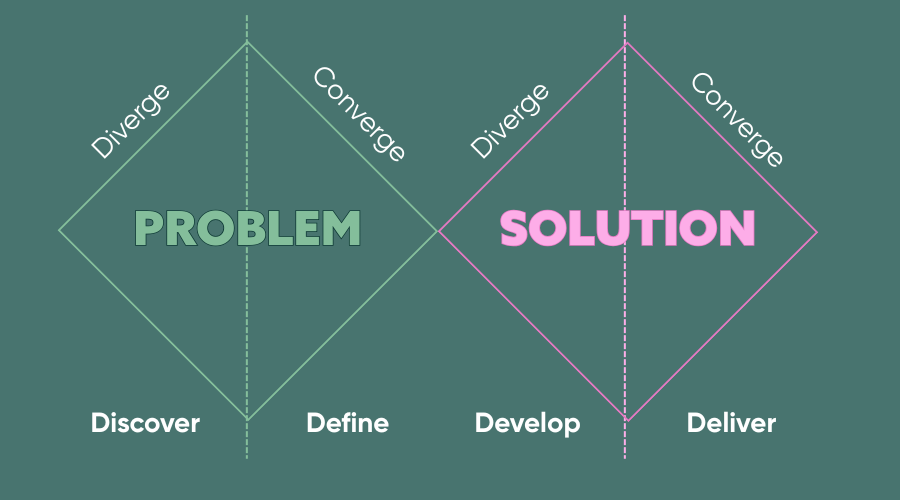
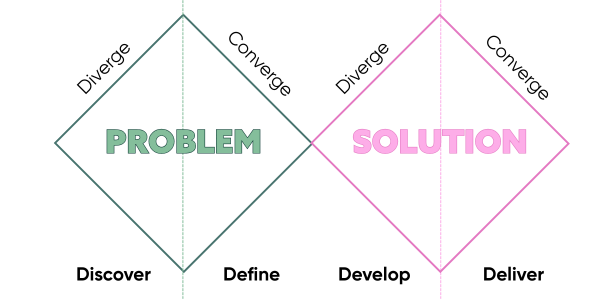
If you’re familiar with design thinking, you’ll have heard of the Double Diamond. It describes the four stages of a design process and requires two types of thinking: Divergent (free-flowing, expansionary) and convergent (focused, narrow).
Divergent thinking is a critical part of any creative (or strategic!) endeavour – you can’t narrow in on the best problems and solutions until you’ve allowed yourself to think broadly first.
How does this relate to the 5 Whys? Whenever we run this activity, we come up against the same challenge: A lot of people race through the questions, tick the exercise off, and get straight back to the solution they’ve already identified. They apply convergent thinking to a tool that also requires divergent thinking.
What’s the difference?
While the questions may all look the same, the first “why” or two in the 5 Whys are an opportunity to set aside your ideas, challenge your biases, and explore multiple possible causes before narrowing in again. In order to do that, you have to let go of what you think you know and be open to completely changing paths. That takes a lot more brainpower (and curiosity) than moving straight into convergent mode and using the tool to simply reinforce your thinking.
See the challenge? On the surface, both processes look the same – you still answer the 5 Whys. However, depending on your approach, you’ll get to very different answers. That’s the difficulty with strategy. You can teach the tools, but the effectiveness comes down to how they’re used. The good news is, while strategic thinking can’t be taught, it can be learned.
Escape the trap of proving yourself right
If you’ve been reading a while, you know there’s a difference between busyness and effectiveness. While convergent thinking will keep you moving, divergent thinking will ensure you’re going in the right direction.
So how do we practice this in the real world? A simple mindset shift.
Instead of trying to prove ideas, decisions, and outputs are correct, strategic thinkers treat them as a first draft that needs improving.
In practice, this means seeing constructive feedback as additive – a way to gain valuable insights and enhancements, not as a critique of our work. It can be as simple as a tweak to our motivations and words when asking for feedback: Instead of asking “Is this good?” try, “What would make this better?”
It’s also challenging ourselves to use tools like the 5 Whys to wind up in a different place than where we started.
Instead of seeing pivots as a failure or a sign that we don’t have good ideas, we actively invest in uncovering and testing our assumptions. And if we find our first draft was completely wrong, we celebrate – it means we’ve successfully applied strategic thinking to improve our work.
30 second action:
This week, show someone a first draft of your idea, output or problem you’re trying to solve and ask, “What would make this better?”
Weekly leadership insights, straight to your inbox
You’ll get one article, insights from the web, a recommended book and podcast, upcoming events, and a 30-second action.
Are you taking initiative, or taking over? When initiative is literally in the job description, why does it backfire? Well, the problem isn't initiative; it's knowing the right level to apply.
Sick of taking on other people's problems? Is solving other people’s problems really an act of care? Women might be great problem-solvers, but we don’t always address the problems this can create.
Get bite-sized career development, straight to your inbox
Bite-sized career development, straight to your inbox